June 3rd 2026
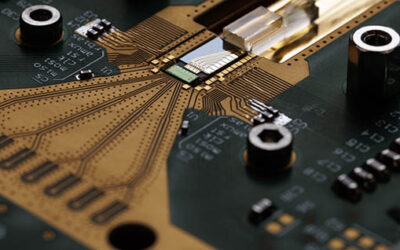
The TERA6G project has made breakthrough developments toward a deployable “fiber-over-the-air” telecom solution that combines integrated photonics, radio frequency (RF) electronics, and terahertz (THz) antenna arrays. With PHIX as an advanced packaging partner and 3D module design architect, the EU project has produced prototypes that demonstrate a clear path toward terabit-per-second (Tbps) 6G wireless data transmission with 2D beam steering.
From fiber to free-space wireless RF communication
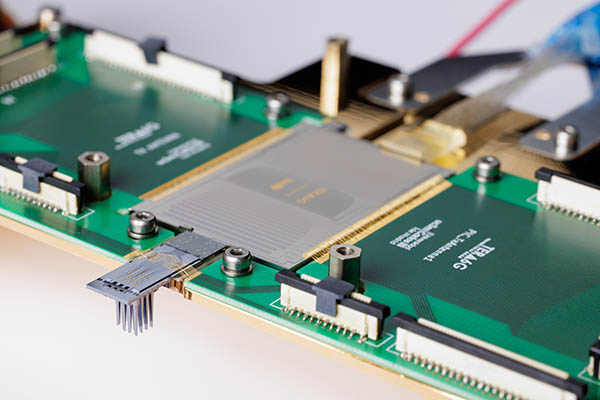
TERA6G photonic transmitter antenna module
Global data demand continues to accelerate at a pace that is surpassing the capabilities of current wireless infrastructure. From AI-driven applications and cloud computing to immersive digital experiences and real-time industrial systems, the volume, speed, and responsiveness required from connectivity are increasing rapidly.
While fiber optic networks provide the necessary bandwidth, extending that performance wirelessly has remained a challenge. Existing technologies, including 5G, are approaching their practical limits in terms of capacity and spectrum efficiency, particularly in dense, data-intensive environments. These limits become most visible in scenarios such as crowded events and industrial IoT networks, where a high density of devices is demanding high data rate transmissions at the same time.
To address this gap, new approaches are needed that go beyond incremental improvements. Terahertz (THz) wireless communication, enabled by photonic chip technology, is emerging as a promising pathway to deliver fiber-like speeds over the air, unlocking the next generation of high-capacity and low-latency connectivity.
Limitations of conventional electronics
A key constraint behind the move to 6G communication is the fundamental limitation of conventional electronic approaches at extremely high frequencies. As systems move toward the THz range, losses in the transmission lines of the circuits increase, signal integrity becomes harder to maintain, and generating or processing ultra-wide bandwidths with purely electronic components becomes increasingly inefficient and complex.
Scaling bandwidth and frequency simultaneously introduces trade-offs in power consumption, heat dissipation, and system stability. In practice, this makes it difficult for electronics alone to support the sustained terahertz bandwidths required for future wireless links.
Uniting European innovation power
The TERA6G project, funded by the European Union, is addressing this challenge by developing wireless transceiver modules that use integrated radio frequency (RF) photonics, in combination with advanced beam steering. The project, which builds on the results and expertise gathered in several past projects such as Teraway, unites 10 partners from the 5 EU countries Finland, Spain, the Netherlands, Germany, and Greece. PHIX is contributing as an advanced packaging partner with extensive expertise in 3D module design, integration of integrated photonics and RF electronics, and thermal management.
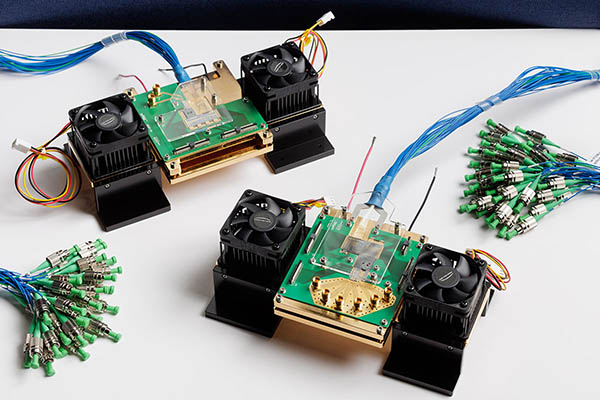
TERA6G tunable laser transmitter and receiver modules
Tunable lasers and beam steering antennas
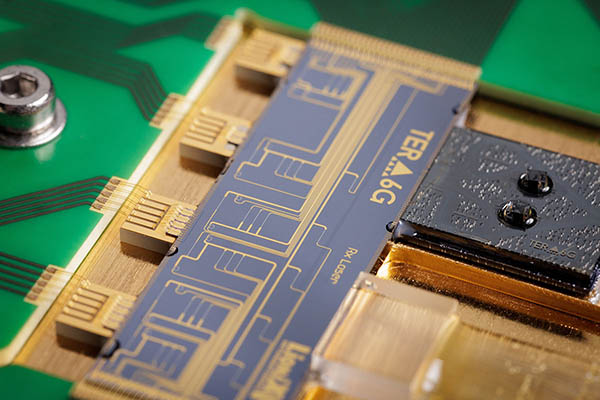
Ten gain chips, grouped in arrays, edge coupled to a SiN PIC in the TERA6G receiver laser module
TERA6G is meeting the wireless Tbps data throughput requirements for use in data-intensive environments by combining millimeter-wave and THz operating bands with massive multiple-input multiple-output (mMIMO) multi-antenna techniques. This is achieved with optical beamforming networks (OBFNs), developed by LioniX International, which utilize phased array antennas to steer a large number of beams without any moving parts.
These high frequencies and beam steering techniques are achieved through hybrid integration of photonic integrated circuits (PICs) of various material platforms. Indium phosphide (InP) gain chip arrays and optical modulators are combined with silicon nitride (LioniX’s proprietary TriPleX platform) to create high optical power tunable lasers and beam formers. Another key integration technology are polymer ‘photonic motherboards’ (Fraunhofer HHI’s PolyBoard technology), which include integrated optical isolators. PHIX performed the optical assembly by edge coupling the PICs and fiber arrays using active alignment assisted by waveguide alignment loops.
The PICs are interfaced with DC and RF electronics through wire and ribbon bonds to printed circuit boards (PCBs) designed by the Carlos III University of Madrid (UC3M) and LeapWave Technologies.
As a module architecture co-designer and advanced packaging partner, PHIX also faces the challenge of thermal management. Several subsystems locally generate up to 50W of power, while the modules need to be kept at a stable operating temperature in order to function consistently. To tackle this, PHIX designed, simulated, and built a thermal management solution based on thermoelectric (Peltier) coolers (TECs), NTC thermistors, heat sinks, and fans.
In this intermediate stage of the project, the complexity of TERA6G’s solution is managed by spreading the intended functionality over multiple prototype modules, a set of transmitter (Tx) and receiver (Rx) lasers and a set of Tx and Rx antenna devices. The laser and the antenna modules of each type are interconnected by optical fibers.
Bringing together antenna rods and PICs
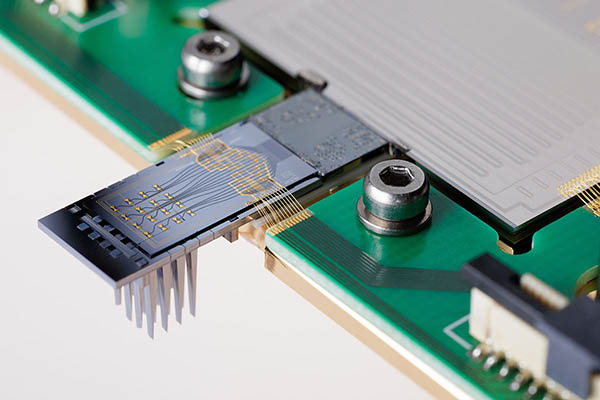
Close-up of the TERA6G transmitter antenna
The latest addition to this set of prototypes, the transmitter antenna module, showcases collaborative and cutting-edge innovation of several project partners. A silicon structure provided by UC3M forms the 4×4 antenna rod array for the InP THz emitter array by Fraunhofer HHI, which is connected to a LioniX SiN THz beam steering PIC. Surrounding this architecture, which was 3D-modeled and engineering by PHIX, is a PCB provided by UC3M. LeapWave Technologies performed electromagnetic radiation simulations to assess the impact of the package on the emitted beam profile.
There proved to be a strong interaction between the design of these components and their assembly sequence. For example, this was manifested in the placement of the delicate antenna rod array in relation to processes such as epoxy curing and wire bonding. To solve this, PHIX encouraged the project partners to take on a system-level integration mindset, in which component designs are not only optimized for individual performance, but also for the functioning and manufacturability of the module as a whole.
This close integration of antenna radiation, integrated photonics, and electronics is an important milestone demonstrating a feasible system-level technology capable of delivering Tbps data rates that are far beyond what current 5G networks can offer.
End uses for next-gen wireless transceivers
As these systems mature, they can make impact in multiple data-intensive environments. Not only can they increase performance in existent technologies, but they also enable new applications that require extreme data rates and low latency, such as advanced automation, immersive communication, and distributed computing.

6G network infrastructure
THz wireless can enable ultra-high-capacity links for dense urban environments, providing the coverage and bandwidth needed in crowded urban areas and large events such as concerts or sports matches. This will not only enhance the connectivity of the public, but also of emergency services and law enforcement. This application is a main focus of TERA6G and the reason that large telecom providers Telefónica and Intracom Telecom are among the consortium partners.

Advanced industrial systems
Real-time, high-bandwidth wireless connectivity will play a key role in further enabling manufacturing 4.0, transforming production environments through digital technologies like Internet of Things (IoT), AI-powered synchronized robotics, and proactive predictive maintenance. For this application area, TERA6G partner Cumucore brings a lot of expertise to the consortium.

Healthcare innovation
High-speed, low-latency wireless communication can enhance data-intensive medical applications, from imaging and (remote) diagnostics to robotics-assisted surgical systems.

Immersive technologies
Emerging use cases in immersive technologies such as augmented, virtual, and mixed reality (AR/VR/MR), holographic communication, and real-time simulation environments depend on the performance levels that THz wireless aims to deliver.

Data center and edge connectivity
Short-range Tbps wireless links offer new options for high-speed interconnects within data centers and between distributed compute nodes, improving flexibility and reducing physical constraints.
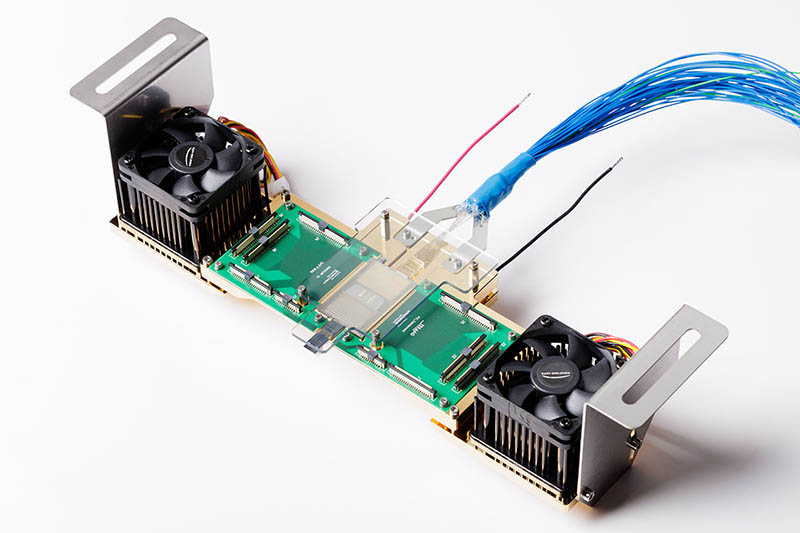
The TERA6G transmitter antenna module has a rack-mountable format
Building the future of wireless communication
This successful demonstration of photonics-enabled THz transceiver modules by the TERA6G project is an important step in bridging the gap between laboratory-level photonic innovation and the development of scalable, industrial-grade hardware solutions for next-generation 6G systems. By combining 3D mechanical design, optical-electrical integration, and thermal engineering, PHIX has transformed advanced laboratory research concepts into practical, high-performance modules suitable for evaluation in relevant scenarios.
This collaborative development shows that the path toward ultra-fast, high-capacity wireless systems is not just emerging. It is already being engineered!
This work is part of the TERA6G project, which has received funding from the European Union’s Horizon Europe research and innovation program under grant agreement no. 101096949.
Discover photonics packaging solutions at PHIX
Are you curious how PHIX can help transform your PIC-based innovations from concept to reality? Our prototype packaging offering is a good place to start. With our guidance on PIC design best practices for effective packaging, you unlock a range of standardized but flexible packaging solutions that are assembled at low cost and short lead times on automated equipment.
Once your rapid prototyping cycle is completed, PHIX is very well-equipped to support your scaleup path. We have processes to cover all aspects of integrated photonics and MEMS packaging, and our in-house production capacity exceeds 100k units per month, expandable even further by our high-volume production partners.